Plastic waste has become one of the biggest environmental challenges worldwide. However, an efficient Plastic Recycling Process helps recover valuable materials, reduces landfill waste, and supports a circular economy. Today, businesses and communities are increasingly adopting Plastic Waste Recycling services to minimize environmental impact while conserving natural resources.
Moreover, advancements in recycling technology have made it possible to convert discarded plastics into high-quality raw materials. According to the U.S. Environmental Protection Agency (EPA), mechanical recycling remains the most widely used method, while advanced chemical recycling complements it by processing certain hard-to-recycle plastics.
What Is Plastic Waste Recycling?
Plastic waste recycling is the process of collecting, sorting, cleaning, and converting used plastic into reusable raw materials. Recycling facilities process recyclable plastics and transform them into pellets or resin that manufacturers use to create new products.
Furthermore, recycling reduces dependence on virgin plastic made from fossil fuels. As a result, industries can lower resource consumption while supporting sustainable manufacturing practices.
Understanding the Plastic Recycling Process
The Plastic Recycling Process follows a structured sequence to ensure recycled materials meet industrial quality standards. Each stage plays an essential role in producing clean and reusable plastic.
Step 1: Collection
The journey begins with collecting plastic waste from households, waste industries, commercial establishments, and collection centers.
Additionally, many organizations now use digital tracking systems to improve traceability and ensure responsible waste management.
Step 2: Sorting
Next, plastics are sorted according to resin type, color, and quality.
Modern recycling facilities often use Near-Infrared (NIR) optical sorting systems to separate different plastic polymers accurately. Proper sorting significantly improves the quality of recycled materials.
Step 3: Shredding
Plastics are shredded into tiny particles after sorting.
This process increases the surface area, making washing and further processing much more effective. Consequently, contaminants can be removed more efficiently.
Step 4: Washing
The shredded plastic undergoes intensive washing to eliminate dirt, labels, adhesives, oils, and food residues.
Clean material is essential because contamination can reduce the quality of recycled plastic. Therefore, advanced washing systems are widely used in modern recycling plants.
Step 5: Melting and Pelletizing
Once cleaned and dried, the flakes are melted and filtered to remove remaining impurities.
Subsequently, the molten plastic is converted into uniform pellets that serve as raw material for manufacturing new plastic products.
Step 6: Manufacturing New Products
Finally, manufacturers use recycled plastic pellets to produce bottles, containers, automotive parts, packaging materials, furniture, and construction products.
Thus, the Plastic Recycling Process completes a circular production cycle that conserves valuable resources.
Mechanical vs. Chemical Recycling
There are two primary methods used in the Plastic Recycling Process.
Mechanical Recycling
Mechanical recycling involves sorting, cleaning, shredding, melting, and remolding plastics without changing their chemical structure.
Because it is efficient and widely established, this method remains the dominant recycling approach worldwide.
Chemical Recycling
In contrast, chemical recycling breaks plastic polymers into smaller chemical building blocks using thermal or chemical processes.
Although this technology is still expanding, it can process certain plastic waste streams that mechanical recycling cannot handle. Therefore, it complements traditional recycling rather than replacing it.
The Plastic Recycling Cycle
The Plastic Recycling Process forms a continuous loop that supports a circular economy.
The cycle includes:
- Plastic product usage
- Waste collection
- Sorting
- Cleaning
- Recycling
- Manufacturing new products
- Consumer reuse
Meanwhile, consumers play an important role by rinsing recyclable containers and disposing of them correctly. Small actions significantly improve recycling efficiency.
In addition, organizations offering Recycling Services in Noida Sector 18 help businesses manage recyclable waste responsibly while supporting environmental compliance.
Common Recyclable Plastics
Several plastic types are commonly recycled.
- PET (RIC 1) – Water bottles and beverage containers
- HDPE (RIC 2) – Milk bottles and detergent containers
- LDPE (RIC 4) – Plastic bags and shrink wraps
- PP (RIC 5) – Food containers, bottle caps, and automotive components
However, proper segregation remains essential because different plastics require different recycling techniques.
Benefits of the Plastic Recycling Process
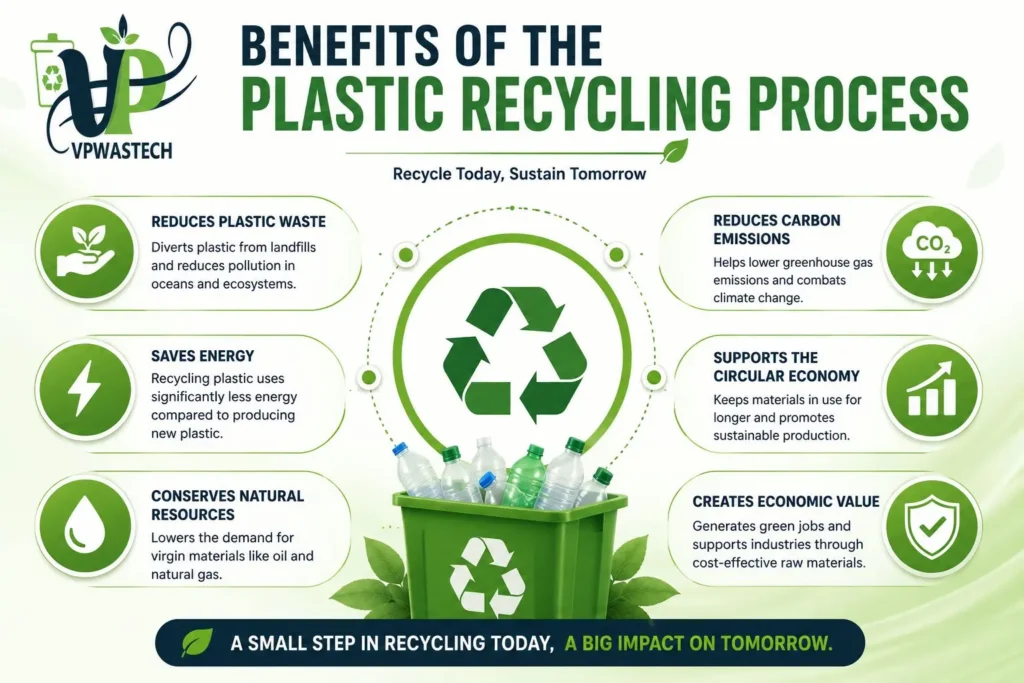
The Plastic Recycling Process offers environmental, economic, and industrial advantages.
Conserves Natural Resources
Recycling reduces the demand for virgin plastic manufactured from petroleum-based raw materials.
Reduces Landfill Waste
Additionally, recycling diverts significant amounts of plastic from landfills and natural ecosystems, reducing environmental pollution.
Supports the Circular Economy
Instead of discarding plastic after one use, recycled materials remain in circulation for manufacturing new products.
Saves Energy
Manufacturing products from recycled materials often requires less energy than producing them from new raw materials, depending on the material and process used.
Encourages Sustainable Manufacturing
Furthermore, companies using recycled plastics can reduce raw material consumption and improve resource efficiency, supporting long-term sustainability goals.
Challenges in Plastic Recycling
Despite significant progress, the Plastic Recycling Process still faces several challenges.
For example:
- Mixed plastic materials
- Food contamination
- Multi-layer packaging
- Limited recycling infrastructure
- Difficulty recycling certain plastic types
Nevertheless, continuous improvements in sorting technology, washing systems, and advanced recycling methods are helping overcome these challenges.
Conclusion
The Plastic Recycling Process is essential for reducing plastic pollution, conserving natural resources, and promoting a sustainable circular economy. From collection and sorting to pelletizing and manufacturing, every stage contributes to giving plastic a second life. Furthermore, businesses that adopt responsible recycling practices not only reduce environmental impact but also support long-term resource efficiency. If your organization is looking for reliable Plastic Waste Recycling Services in Noida, partnering with an experienced recycling provider can help ensure environmentally responsible plastic waste management while supporting sustainability goals.