A Solar Panel Recycling Plant helps businesses recover valuable materials from discarded photovoltaic (PV) modules. As solar energy installations expand, managing end-of-life panels becomes increasingly important. Therefore, choosing the right manufacturer is essential for building an efficient recycling business.
According to a 2025 study by the Council on Energy, Environment and Water (CEEW), India could generate approximately 11,221 kilotonnes of solar waste by 2047. Moreover, the study estimates that India will need 299 recycling facilities to manage this waste.
CEEW
Consequently, the india solar panel recycling market offers opportunities for businesses investing in recycling infrastructure. However, success depends on selecting suitable machinery, reliable technology, and experienced manufacturers.
What Is a Solar Panel Recycling Plant?
A solar panel recycling facility processes discarded photovoltaic modules and recovers reusable materials. These materials include glass, aluminium, silicon, copper, silver, and other metals.
Furthermore, recycling reduces the need for virgin raw materials and supports a circular economy. According to the US Environmental Protection Agency, crystalline-silicon panels generally have an expected lifespan of 25 years or longer.
US EPA
Therefore, recycling infrastructure will become increasingly important as older solar installations reach the end of their operational lives.
How Does the Recycling Process Work?
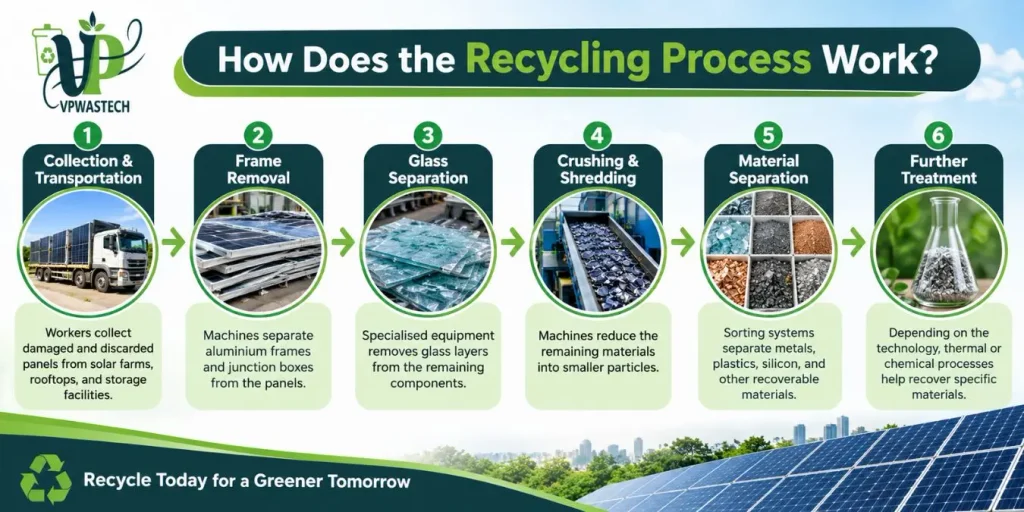
Several crucial steps are often involved in the recycling process:
- Collection and transportation: Workers collect damaged and discarded panels from solar farms, rooftops, and storage facilities.
- Frame removal: Machines separate aluminium frames and junction boxes from the panels.
- Glass separation: Specialised equipment removes glass layers from the remaining components.
- Crushing and shredding: Machines reduce the remaining materials into smaller particles.
- Material separation: Sorting systems separate metals, plastics, silicon, and other recoverable materials.
- Further treatment: Depending on the technology, thermal or chemical processes help recover specific materials.
However, the exact process depends on panel construction and the manufacturer’s equipment configuration.
Important Factors to Consider When Choosing Manufacturers
Selecting suitable equipment requires more than comparing machinery prices. Instead, businesses should evaluate technical capabilities, processing requirements, and long-term support.
1. Check Manufacturing Experience
First, examine the manufacturer’s experience in photovoltaic recycling equipment. Look for established product information, technical documentation, and relevant project references.
Additionally, ask whether the manufacturer understands different panel structures. This knowledge helps ensure that the equipment matches your processing requirements.
A reliable manufacturer should also explain the complete recycling process rather than offering individual machines without considering the overall production line.
2. Evaluate Recycling Technology
Technology directly affects material recovery, product quality, and operating costs.
For example, mechanical crushing and separation systems can process single-glass crystalline-silicon panels. Meanwhile, double-glass panels may require specialised separation techniques.
VP Wastech lists both crushing and pyrolysis processes for different solar panel configurations. Its product information identifies crushing for single-glass panels and pyrolysis for double-glass panels.
VP Wastech
Therefore, ask manufacturers to explain the advantages, limitations, and suitability of each technology before making an investment.
3. Check Processing Capacity
Every recycling business has different operational requirements. Some businesses need small processing lines, whereas industrial facilities require higher capacities.
Before purchasing a Solar Panel Recycling Plant, consider:
- Daily and annual processing requirements.
- Available factory space.
- Electricity consumption.
- Labour requirements.
- Future expansion plans.
- Expected material output.
Furthermore, request technical specifications for each proposed machine. This will help you compare different manufacturers accurately.
4. Examine Material Recovery Efficiency
Material recovery plays an important role in recycling profitability. Therefore, evaluate how effectively the equipment separates glass, aluminium, silicon, copper, and silver.
Ask manufacturers for documented recovery rates and material purity results. Additionally, request sample processing results for your specific panel types.
Do not rely entirely on advertised recovery percentages. Instead, verify the testing conditions and actual output quality.
5. Understand Environmental and Regulatory Requirements
Environmental compliance should remain a priority when establishing a recycling facility in India.
The E-Waste (Management) Rules, 2022 include provisions for solar photovoltaic modules, panels, and cells. Furthermore, CPCB issued specific storage and handling guidelines in March 2026.
eprewaste.cpcb.gov.in+1
These guidelines state that solar waste should not be dumped in open areas or landfills. They also specify that waste intended for recycling should be handed over to registered e-waste recyclers.
eprewaste.cpcb.gov.in
Therefore, choose equipment that supports environmentally responsible processing and discuss applicable compliance requirements with qualified professionals.
6. Compare Automation and Safety Features
Automation can improve production consistency and reduce manual handling. Therefore, check whether the manufacturer offers automatic feeding, frame removal, crushing, sorting, and centralised control systems.
Additionally, examine dust collection and emission-control arrangements. These systems help maintain safer working conditions and support environmentally responsible operations.
A well-designed Solar Panel Recycling Plant should integrate essential processing and safety equipment into one coordinated system.
7. Evaluate Customisation Options
Different recycling projects require different equipment configurations. For example, a facility processing monocrystalline panels may have different requirements from one handling bifacial modules.
Consequently, manufacturers should offer solutions based on:
- Types of solar panels.
- Required processing capacity.
- Factory layout and available space.
- Target recovered materials.
- Budget and operational requirements.
Customisation also helps businesses avoid purchasing unnecessary machinery.
8. Check Installation and After-Sales Support
Equipment installation is only the beginning of a recycling project. Moreover, operators need proper training to maintain consistent production.
Before finalising an agreement, ask about:
- Installation and commissioning services.
- Operator training programmes.
- Equipment warranties.
- Spare parts availability.
- Technical assistance.
- Maintenance requirements.
Reliable after-sales support can reduce unexpected downtime. As a result, businesses can maintain smoother operations over the long term.
The Significance of Solar Panel Recycling in India?
India’s growing solar capacity creates a need for better end-of-life management. According to CEEW’s 2025 research, recovered materials could create a market opportunity worth approximately ₹3,709 crore by 2047.
CEEW
Furthermore, recycling can reduce dependence on imported critical minerals and support domestic manufacturing.
Therefore, investing in appropriate recycling technology can help businesses participate in the developing solar panel recycling india industry.
However, businesses must also establish proper collection, transportation, and processing arrangements. These steps ensure responsible management throughout the recycling chain.
Why Consider VP Wastech for Solar Panel Recycling Solutions?
Choosing an experienced machinery supplier can simplify equipment selection and project planning.
VP Wastech offers solar panel recycling machinery designed to recover materials from end-of-life photovoltaic modules. Its published product information describes crushing, frame removal, glass separation, and material sorting systems.
VP Wastech
Complete Equipment and Engineering Solutions
VP Wastech provides information about different recycling configurations for single-glass and double-glass solar panels.
Additionally, its website describes services such as factory layout design, installation, worker training, and spare parts supply.
VP Wastech
These services can help businesses plan their recycling facilities according to their operational requirements.
Solutions for Different Panel Types
Different photovoltaic panels require suitable processing methods. Therefore, businesses should discuss their raw materials and recovery objectives before selecting equipment.
VP Wastech lists solutions for crystalline-silicon and bifacial solar panels. However, buyers should verify the technical specifications and recovery performance for their particular requirements.
VP Wastech+1
A properly configured Solar Panel Recycling Plant can help businesses recover valuable materials while supporting responsible resource management.
Conclusion
Choosing the right Solar Panel Recycling Plant manufacturer requires careful evaluation of technology, processing capacity, recovery efficiency, safety, and after-sales support.
Moreover, businesses should prioritise manufacturers that understand different photovoltaic panel structures and offer customised solutions. Proper planning also helps improve solar panel waste disposal and material recovery.
A reliable Solar Panel Recycling Plant can support long-term business growth while reducing environmental impact. Therefore, compare technical specifications, verify performance claims, and evaluate the manufacturer’s service capabilities before investing.
VP Wastech offers recycling equipment and customised solutions for businesses planning to enter the solar recycling industry. Contact its team to discuss your project requirements and explore suitable machinery options.