Businesses dealing with plastic packaging in Noida need to understand the documentation involved in Extended Producer Responsibility (EPR) registration. In particular, producers, importers, and brand owners must provide accurate business and product information through the applicable CPCB EPR system. Therefore, preparing the documents required for epr certificate in advance can make the registration process more organized and reduce the possibility of clarification requests. Businesses looking for an EPR Plastic Waste Certificate in Noida should also ensure that their information and supporting documents remain consistent throughout the application.
CPCB’s plastic packaging guidance specifies several documents and information requirements for PIBOs (Producers, Importers and Brand Owners). Moreover, the exact requirements can vary according to the applicant type and applicable category.
Why Are EPR Documents Important?
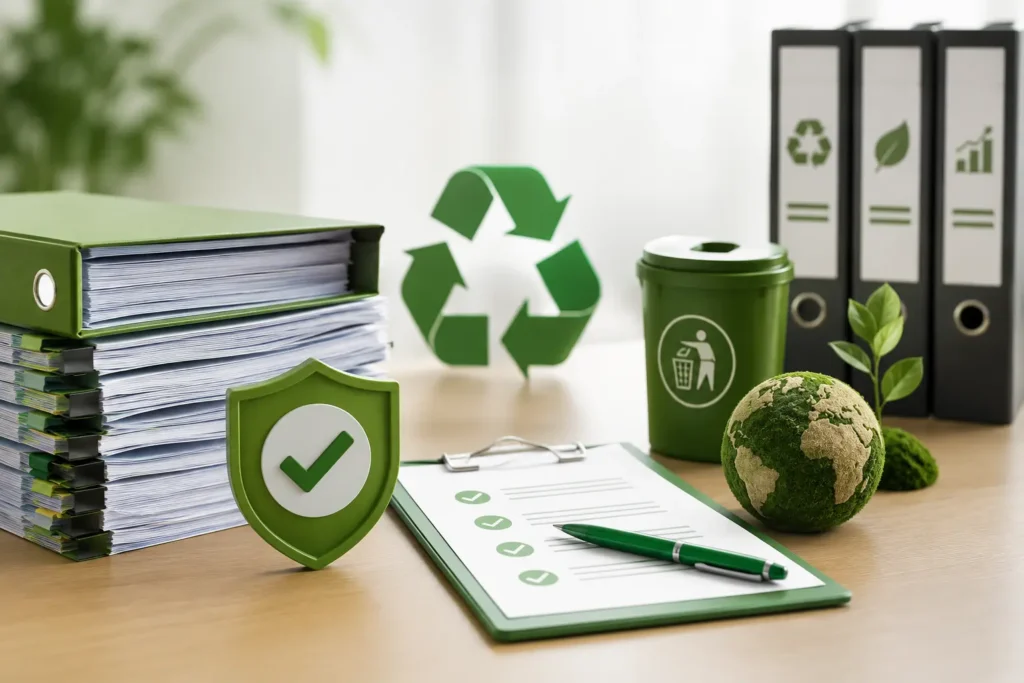
EPR registration involves the submission and verification of business, authorized-person, and plastic-packaging information. Consequently, incomplete or inconsistent information can create problems during application processing.
Important facts including the applicant’s legal identity, business structure, authorized representative, and plastic packaging operations are verified by CPCB with the aid of the paperwork needed for the epr certificate.
Therefore, businesses should review every document before uploading it. Additionally, the information entered on the portal should match the supporting documents.
Documents Required for EPR Certificate
The documents required for epr certificate depend on the applicant’s category and circumstances. However, CPCB’s current plastic packaging guidance identifies several important documents and information that applicants should keep ready.
1. Company PAN, CIN and GST Documents
For applicable company applicants, CPCB’s guidance requires PDF copies of the company’s PAN, CIN, and GST documents during the registration process. These documents help establish the legal and tax identity of the business.
Furthermore, CPCB’s FAQ states that proprietorship and partnership firms should provide PAN and GST information, while CIN applies to companies registered under the Companies Act.
2. Authorized Person’s PAN and Aadhaar
The authorized person’s identification documents are another important part of the application. CPCB’s guidance specifically lists the PAN and Aadhaar of the authorized person among the required documents.
As a result, businesses should ensure that the authorized person’s information is entered correctly and matches the submitted documents.
3. Business and Company Details
Applicants need to provide important company information during sign-up, including the legal name, trade name, business type, company type, registered address, PAN, and applicable CIN details.
The documents required for epr certificate therefore work alongside the information entered into the portal. For this reason, businesses should maintain consistency between their official records and the application.
CPCB’s guidance also asks applicants to provide the name, designation, mobile number, and PAN details of the authorized person.
4. Product Details and Plastic Packaging Information
EPR registration is not limited to company identification. Applicants must also provide details about the products produced or marketed. CPCB’s instruction sheet requires details regarding the type and quantity of products produced or marketed.
In addition, applicants need representative pictures of plastic packaging covering the applicable EPR categories. The current guidance identifies four plastic packaging categories, including rigid plastic packaging, flexible plastic packaging, multilayered plastic packaging, and compostable plastic packaging.
5. Supporting Documents for Applicable Categories
Some businesses may need additional supporting documentation depending on their classification. For example, CPCB’s guidance for micro and small producers, sellers, manufacturers, and importers of raw materials identifies Udyam certification as supporting documentation for the micro and small category.
Similarly, importers of raw materials covered under that guidance need to keep a copy of their IEC certificate available. Supporting documents related to registration with the District Industries Centre or the relevant state or Union Territory authority may also apply.
6. Previous EPR Registration Certificate
For renewal applications, CPCB’s instruction sheet lists a copy of the previous registration certificate as an applicable document.
Therefore, businesses renewing an existing registration should keep their previous EPR registration records accessible. This can help them provide the required information accurately during the renewal process.
What Information Should Businesses Check Before Uploading?
Preparing the documents required for epr certificate is only the first step. Businesses should also check whether the information across their documents is consistent.
For example, the legal name, registered address, PAN, GST details, and authorized-person information should be reviewed carefully before submission. Likewise, product quantities and packaging information should accurately represent the business activities being declared.
CPCB’s guidance emphasizes the submission of relevant and accurate information. Therefore, businesses should avoid uploading outdated, unclear, or inconsistent documents.
How Can Businesses Simplify EPR Documentation?
EPR documentation can become complicated when a business operates across different product categories or needs additional supporting records. In such situations, professional assistance can help businesses organize their information before submission.
An EPR Registration Consultant in Noida can assist businesses with document preparation, information verification, application filing, and responding to procedural requirements. However, applicants should always verify the latest CPCB requirements because EPR procedures and online systems can change.
Most importantly, businesses should rely on current CPCB instructions rather than outdated checklists or unofficial information.
Common Documentation Mistakes to Avoid
Businesses should carefully review the documents required for epr certificate before submitting an application. Some common areas that deserve attention include:
- Mismatched company information
- Incorrect authorized-person details
- Missing PAN, GST, or CIN information where applicable
- Incorrect product quantity information
- Missing packaging photographs
- Failure to provide applicable category-specific documents
- Uploading an incorrect or outdated registration certificate during renewal
Consequently, a document checklist can help businesses identify missing information before submission.
Why Choose VP Wastech for EPR Assistance?
VP Wastech can support businesses by helping them understand the documentation process and organize their EPR compliance requirements. Moreover, professional assistance can make it easier to identify information gaps before an application is submitted.
The documents required for epr certificate should always be prepared according to the applicant’s specific category and the latest CPCB instructions. Businesses should also remember that the plastic EPR portal has transitioned to the Common EPR Portal, making it particularly important to follow current official procedures.
Conclusion
Understanding the documents required for epr certificate is an important step for businesses seeking EPR registration for plastic packaging. Company identification documents, authorized-person details, product information, packaging details, and applicable supporting certificates all play a role in preparing a complete application.
Furthermore, requirements can differ according to the applicant’s business structure and category. Therefore, businesses should review the latest CPCB guidance before submitting their application. With support from Best EPR Registration Experts in Noida, businesses can organize their documentation more effectively and approach EPR compliance with greater confidence.
For the most reliable information, applicants should always verify requirements through the latest CPCB portal and official guidance because EPR procedures can be updated over time.